Showing posts with label Moon. Show all posts

Sunday, 15 July 2012

Jupiter Occultation

On the early morning of July 15, 2012, Jupiter was occulted by the moon. To witness this relatively rare event, I packed my car with astronomy equipment, went to bed early and set my alarm at 2:00 a.m. (my wife kindly requested me to sleep on the coach...). When the alarm went off, I quickly took a peek outside: rain. No worry, this was exactly what the weather forecast predicted. The skies would clear just before dawn, so time to go to a place outside town with a clear view to the east.

I arrived around 2:45 a.m.. The occultation would begin at (or around) 3:52 a.m. so I had time enough to set up the equipment. In the meantime it had stopped raining. I could already see several of the brighter stars. There were too many clouds to completely witness the start of occultation, but luckily for me, the final patches of clouds disappeared, so I was able to observe (and photograph) the rest of the event.

Technical details of the pictures can be found on my website.


Saturday, 28 January 2012

City Astronomy

Dutch Astronaut André Kuipers took an image of the Netherlands (and Belgium) from space.


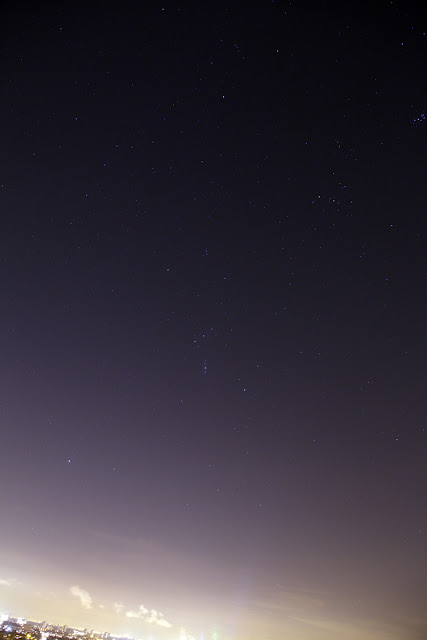
I live in the centre of the red cross hair: one of the most light polluted areas of the Netherlands. The bright yellow spots are caused by assimilation lights of greenhouses.

What does this mean for (amateur) astronomy? Well, kids who grow up in this part of the Netherlands cannot experience the splendour of the milky way. Most kids don't even know the existence of it, until they go on a holiday to a "dark" place. It also means that taking a picture of the Orion constellation with an exposure time of 2 minutes will lead to an overexposed image. The image below was exposed for 10 seconds at ISO 1600 with a Canon 5D Mark II and Canon EF 24-70 mm f/2.8 L USM lens at 25 mm f/5.6.


The only celestial objects in the sky that don't get disturbed by light pollution are the moon and planets. The following picture was taken on the same evening (January 27, 2012) at the public astronomical observatory of Rijswijk, located on top of a 12 storey high apartment building. You can see Jupiter on the top left and the moon and Venus at the lower right. On the foreground, a fellow astronomer is taking pictures of this conjunction. The high antennas are lightning rods. Exposed for 2.5 seconds with the same camera and lens at 24 mm f/5.6 and ISO 1600.


When the moon set, it disappeared in the clouds. Again taken with the same camera, but with a Mamiya 210 mm Sekor-C f/4 lens. Exposed for 4 seconds at f/8 and ISO 1600.

Wednesday, 21 December 2011

From the archives: Moon and Venus conjunctions

According to me, one of the most beautiful sights in astronomy is to see the Moon together with one or more planets in the twilight sky. It gives a feeling of depth when these celestial bodies group together.

After browsing through my image files, I found two images that depict the Moon in conjunction with Venus. I've never published these pictures on my website, so now I share them with you in my blog. Please click on the images to view them at a higher resolution without JPEG artifacts.

The first picture was taken on April 16, 2010, 20h33 local time. The picture was taken with an Olympus E-500 with a 40-150 lens operating at 92 mm f/7.1. The exposure time was 0.5 seconds at ISO 400. (Thank you, Exif data!)


The second picture was taken on December 31, 2010, 7h31 local time. Same camera, same lens, but operating at 55 mm f/7.1. Exposed for 5 seconds at ISO 200.